
Bikes / Carbon–Ti Hybrid
Carbon–Ti Hybrid
The precision of titanium. The performance of carbon.
3D-printed titanium joints integrated with premium T1100 filament winding tubes.
Manifesto
Carbon–Ti Hybrid is Trioneer's flagship answer to a simple observation: no single material is best everywhere on a frame. Titanium is placed where precision and load transfer matter most; carbon is placed where stiffness and weight matter most.
The Purpose
For riders who want the flagship expression of Trioneer's engineering — a structure that treats titanium and carbon as complementary materials rather than competing ones.
Material Architecture
How It's Built
3D-printed titanium joints handle load transfer, structural complexity and precision fitment at the junctions, while T1100 carbon tubes are bonded into those joints where stiffness, weight and laminate control matter most.
Key Engineering Details
What Sets This Platform Apart
- 01
3D Printed Titanium Joint
Additive titanium junctions manage complex load paths at the head tube, seat cluster and bottom bracket.
- 02
T1100 Carbon Tube with Filament Winding & High-Pressure Molding
Precision-wound high-modulus carbon fibers, pressure-molded for superior compaction, stiffness, strength, structural consistency, and optimized weight.
- 03
Integrated Seat Mast
Engineered for precise power transfer, reduced weight, and a clean aerodynamic profile, seamlessly blending carbon performance with Trioneer’s distinctive Carbon-Ti craftsmanship.
- 04
3D Bespoke Dropout Hanger
Precision 3D-printed titanium, engineered for superior stiffness, accuracy, durability, and personalized high-end craftsmanship.
- 05
Precision Bottom Bracket
The bottom bracket junction is printed and machined for a precise, creak-free interface.
- 06
Internal Cable Routing
Housing and hydraulic lines route internally through the titanium joints and carbon tubes.
Geometry
Built Around Rider Position
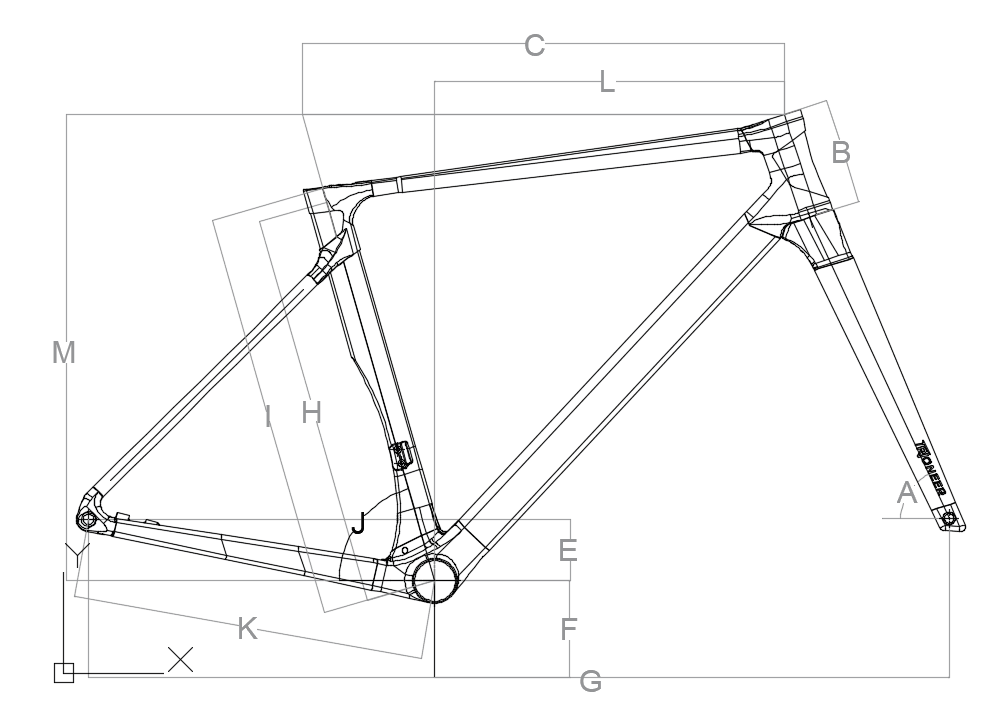
| Size | Rider Height (cm) | Seat Tube (mm) | Effective Top Tube (mm) | Head Tube (mm) | Head Angle (°) | Seat Angle (°) | Fork Length (mm) | Fork Offset (mm) | Chainstay (mm) | Front Center (mm) | BB Drop (mm) | Stack (mm) | Reach (mm) | Standover Height (mm) | Crankarm Length (mm) | Stem Length Suggestion (mm) | STR |
|---|---|---|---|---|---|---|---|---|---|---|---|---|---|---|---|---|---|
| XS/47 | 155–167 | 448.5 | 515.5 | 100 | 71.5 | 74.5 | 377 | 45 | 405 | 570.7 | 74 | 506.7 | 372.5 | 721.4 | 160/165 | 80/90 | 1.36 |
| S/52 | 165–175 | 467 | 537.6 | 115 | 72.3 | 74.0 | 377 | 45 | 405 | 583.2 | 73 | 526.4 | 386.7 | 739.5 | 165/170 | 90/100 | 1.36 |
| M/54 | 172–185 | 480.8 | 552.3 | 135 | 72.5 | 73.6 | 377 | 45 | 405 | 593.2 | 72 | 545.2 | 392.5 | 752.1 | 170 | 100 | 1.39 |
| L/56 | 182–192 | 502.0 | 565.6 | 152 | 73.0 | 73.3 | 377 | 45 | 405 | 598.8 | 72 | 563.1 | 397.3 | 775 | 172.5 | 110 | 1.42 |
| XL/58 | 190–195 | 522 | 580.0 | 175 | 73.3 | 73.0 | 377 | 45 | 405 | 610.5 | 72 | 586.2 | 405 | 795.0 | 175 | 120 | 1.45 |
| XXL/61 | 193 | 550.0 | 601.0 | 190 | 73.3 | 72.5 | 377 | 45 | 405 | 621.7 | 72 | 598.5 | 412.0 | 820.0 | 175 | 120 | 1.45 |
Personalization
Make It Yours
Choose a starting configuration below. Every detail is confirmed with you individually during the Bespoke Process.
Joint Finish
Carbon Weave
Accent
Logo Style
Your configuration: As-Printed Texture · Gloss Uni-Directional · Copper Red · Laser-Etched Joint
Testing & Validation
The titanium-to-carbon bonded interface is validated through simulation, bench testing and physical prototypes before production.
Simulation
Load cases and structural behaviour are modelled before anything is cut or printed.
Physical Prototyping
Prototype units are built to confirm fit, structure and manufacturing process.
Bench Testing
Completed structures are tested for alignment, strength and durability.
Gallery
Ready to Build Your Carbon–Ti Hybrid?
Begin with a private consultation, request pricing, or submit your fit data to start the Bespoke Process.